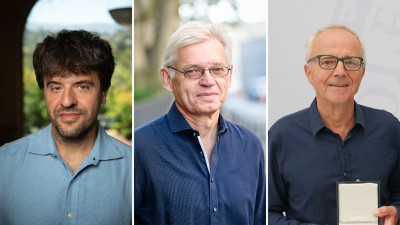
The winners of the 2026 Nobel Prize in Chemistry, Henri Kagan (left) and Kenso Soai (right), were announced on 7 October.Credit: Académie des sciences, Andrew Caballero-Reynolds/AFP via Getty
Two scientists who solved the mystery of why some chemical reactions create molecules that are just one of two possible mirror-image variants have won this year’s Nobel Prize in Chemistry.
Henri Kagan, at the University of Paris-Sud in Orsay, France, and Kenso Soai, at Tokyo University, share the 12-million Swedish kronor (US$1.2-million) prize, announced by the Royal Swedish Academy of Sciences in Stockholm on 7 October.
“I am very excited to receive the very nice news about the Nobel prize. This is one of the most exciting days in my life,” said Soai, speaking to the Nobel committee after the prize was announced, adding that he was out shopping near his house when he received the call.
Although they could occur in either form, life’s building blocks are one-handed or ‘homochiral’ — for example, DNA is right-handed whereas amino acids in humans are left-handed. The prize-winning discovery relates to the key question of how this chemical asymmetry emerges in nature.
In experiments conducted in the 1980s, Kagan showed how a small asymmetry in the handedness of a catalyst can be amplified in the reaction products1. Then, in 1995, Soai designed a reaction in which a chiral product was also itself a catalyst, driving even greater asymmetry in handedness2. Together, this research suggests how natural reactions in living organisms might overwhelmingly produce just one type of mirror-image molecule.
“Henri Kagan and Kenso Soai have provided a solution to a chemical mystery that is over a century old: how homochirality can emerge spontaneously,” said Heiner Linke, chair of the Nobel Committee for Chemistry, in a statement. “The chemical reactions they have developed are spectacular.”
“Kagan is a very, very modest person with a real passion for chemistry, he didn’t care about being famous,” says Olivier Riant, an organometallic chemist at the University of Louvain in Louvain-la-Neuve, Belgium, who was a PhD student in Kagan’s lab at the University of Paris-Sud.
Today, the discoveries are essential for chemists when designing reactions to create drugs, materials and even perfumes. The winners’ discoveries “challenge what we thought we knew and open up entirely new ways of thinking about, and designing, chemical reactions”, says Mónica Pérez-Temprano, a mechanistic chemist at the Institute of Chemical Research of Catalonia in Tarragona, Spain.
One-handed puzzle
Chemists have long known that some molecules come in two mirror-image or chiral forms, known as enantiomers, and that life often operates using just one of these. But when chemists carried out reactions that created such molecules, they usually obtained an even mix of the two types. How living organisms create just one mirror-image was therefore a conundrum.
Catalysts — substances that drive a chemical reaction but are not used up — soon emerged as the key. If the catalyst itself is chiral, this can boost the creation of just one mirror-image molecule. In 1953, Charles Frank, a theoretical physicist at the University of Bristol, UK, suggested that if chemical reactions could produce their own chiral catalyst, it would have a self-reinforcing effect and cause one mirror-image to dominate3.
The winners of the 2001 Nobel chemistry prize, William Knowles, Ryoji Noyori and Barry Sharpless, designed reactions that used a chiral catalyst to steer reactions into creating just one version of a molecule. This year’s prize recognizes Kagan and Soai for going further and realizing Frank’s vision by designing chemical reactions that create their own chiral catalyst.
“Kagan showed how it could be done in principle and then the Soai reaction gave us the first actual real example,” says Jonathan Clayden, an organic chemist at the University of Bristol.
Soai “did a remarkable job of tuning autocatalytic reactions”, says Stephen Fletcher, a synthetic chemist at the University of Oxford, UK. In a chemical mixture, “sometimes you could have one million molecules of one handedness on one side, and one million and one molecules of the other handedness on the other side, and Soai worked on how to amplify the imbalance — that’s remarkable”.
The work of Kagan and Soai has attracted a lot of interest from researchers seeking to explain why molecules of life, such as amino and nucleic acids, tend to be present in only one chiral form, says Furkan Öztürk, a geochemist at the California Institute of Technology in Pasadena who studies the chemistry of the origins of life.
Since the discovery of the Soai reaction, Öztürk says, scientists have sought to determine whether or not a similar reaction could have occurred on ‘prebiotic’ Earth, before life emerged. “The catch is that the [Soai] reaction requires conditions — famously, it cannot run in water — and reagents that are not so compatible with prebiotic Earth conditions and its chemical inventory,” he says. “But I think there is a lot to learn from its fundamental principles to understand the prebiotic origins of homochirality.”
“A lot of people are trying to work on biological relevance to the Soai reaction. I can see this prize being a spark” to rekindle this research, says Fletcher.
Pioneering experiments
Kagan first discovered a reaction in which an initial slight imbalance in the chirality of the catalyst amplified over the course of the experiment, creating a much larger imbalance in the presence of each type of chiral catalyst. Soai then looked for other reactions with this asymmetric effect and, crucially, ones in which the catalyst forms part of the reaction, known as autocatalytic reactions.
doi: https://doi.org/10.1038/d41586-026-03093-0
UPDATES & CORRECTIONS
Update 08 October 2026: This story was updated throughout the day on 7 October to add new information.
References
Puchot, C. et al.J. Am. Chem. Soc.108, 2353–2357 (1986).