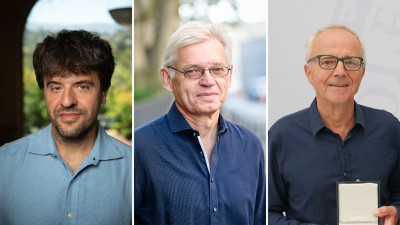
The winners of the 2026 Nobel Prize in Chemistry, Henri Kagan (left) and Kenso Soai (right), were announced on 7 October.Credit: Académie des sciences, Andrew Caballero-Reynolds/AFP via Getty
Two scientists who solved the mystery of why some chemical reactions create molecules that are just one of two possible mirror-image variants have won this year’s Nobel Prize in Chemistry.
Henri Kagan, at the University of Paris-Sud in Orsay, France, and Kenso Soai, at Tokyo University, share the 12-million Swedish kronor (US$1.2-million) prize, announced by the Royal Swedish Academy of Sciences in Stockholm on 7 October.
“I am very excited to receive the very nice news about the Nobel prize. This is one of the most exciting days in my life,” said Soai, speaking to the Nobel committee after the prize was announced, adding that he was out shopping near his house when he received the call.
Although they could occur in either form, life’s building blocks are one-handed or ‘homochiral’ — for example, DNA is right-handed whereas amino acids in humans are left-handed. The prize-winning discovery relates to the key question of how this chemical asymmetry emerges in nature.
In experiments conducted in the 1980s, Kagan showed how a small asymmetry in the handedness of a catalyst can be amplified in the reaction products1. Then, in 1995, Soai designed a reaction in which a chiral product was also itself a catalyst, driving even greater asymmetry in handedness2. Together, this research suggests how natural reactions in living organisms might overwhelmingly produce just one type of mirror-image molecule.
“Henri Kagan and Kenso Soai have provided a solution to a chemical mystery that is over a century old: how homochirality can emerge spontaneously,” said Heiner Linke, chair of the Nobel Committee for Chemistry, in a statement. “The chemical reactions they have developed are spectacular.”
“Kagan is a very, very modest person with a real passion for chemistry, he didn’t care about being famous,” says Olivier Riant, an organometallic chemist at the University of Louvain in Louvain-la-Neuve, Belgium, who was a PhD student in Kagan’s lab at the University of Paris-Sud.
Today, the discoveries are essential for chemists when designing reactions to create drugs, materials and even perfumes. The winners’ discoveries “challenge what we thought we knew and open up entirely new ways of thinking about, and designing, chemical reactions”, says Mónica Pérez-Temprano, a mechanistic chemist at the Institute of Chemical Research of Catalonia in Tarragona, Spain.
One-handed puzzle
Chemists have long known that some molecules come in two mirror-image or chiral forms, known as enantiomers, and that life often operates using just one of these. But when chemists carried out reactions that created such molecules, they usually obtained an even mix of the two types. How living organisms create just one mirror-image was therefore a conundrum.
Catalysts — substances that drive a chemical reaction but are not used up — soon emerged as the key. If the catalyst itself is chiral, this can boost the creation of just one mirror-image molecule. In 1953, Charles Frank, a theoretical physicist at the University of Bristol, UK, suggested that if chemical reactions could produce their own chiral catalyst, it would have a self-reinforcing effect and cause one mirror-image to dominate3.
The winners of the 2001 Nobel chemistry prize, William Knowles, Ryoji Noyori and Barry Sharpless, designed reactions that used a chiral catalyst to steer reactions into creating just one version of a molecule. This year’s prize recognizes Kagan and Soai for going further and realizing Frank’s vision by designing chemical reactions that create their own chiral catalyst.
“Kagan showed how it could be done in principle and then the Soai reaction gave us the first actual real example,” says Jonathan Clayden, an organic chemist at the University of Bristol.
Soai “did a remarkable job of tuning autocatalytic reactions”, says Stephen Fletcher, a synthetic chemist at the University of Oxford, UK. In a chemical mixture, “sometimes you could have one million molecules of one handedness on one side, and one million and one molecules of the other handedness on the other side, and Soai worked on how to amplify the imbalance — that’s remarkable”.
The work of Kagan and Soai has attracted a lot of interest from researchers seeking to explain why molecules of life, such as amino and nucleic acids, tend to be present in only one chiral form, says Furkan Öztürk, a geochemist at the California Institute of Technology in Pasadena who studies the chemistry of the origins of life.
Since the discovery of the Soai reaction, Öztürk says, scientists have sought to determine whether or not a similar reaction could have occurred on ‘prebiotic’ Earth, before life emerged. “The catch is that the [Soai] reaction requires conditions — famously, it cannot run in water — and reagents that are not so compatible with prebiotic Earth conditions and its chemical inventory,” he says. “But I think there is a lot to learn from its fundamental principles to understand the prebiotic origins of homochirality.”
“A lot of people are trying to work on biological relevance to the Soai reaction. I can see this prize being a spark” to rekindle this research, says Fletcher.
Pioneering experiments
Kagan first discovered a reaction in which an initial slight imbalance in the chirality of the catalyst amplified over the course of the experiment, creating a much larger imbalance in the presence of each type of chiral catalyst. Soai then looked for other reactions with this asymmetric effect and, crucially, ones in which the catalyst forms part of the reaction, known as autocatalytic reactions.
doi: https://doi.org/10.1038/d41586-026-03093-0
UPDATES & CORRECTIONS
Update 08 October 2026: This story was updated throughout the day on 7 October to add new information.
References
Puchot, C. et al.J. Am. Chem. Soc.108, 2353–2357 (1986).
Casa de Goa located in Lisbon publishes a bimonthly magazine with articles pertaining to everything Goan. The latest issue contains articles on how genetics and genetic genealogy has been applied to discover how Goa was populated from ancient times.
The magazine is bilingual Portuguese / English. You can access it through the above link.
Hepatitis B virus can cause acute and chronic infections in the liver. Credit: Linda Stannard, UCT/SPL
A wave of epigenetic therapies is offering hope for new ways to treat chronic hepatitis B — a lingering liver infection that is caused by the hepatitis B virus (HBV) and affects more than 250 million people around the world. Currently available drugs often fail to eradicate the virus from the body.
Gene-editing therapies — which make cuts to DNA strands — have been explored but they can increase cancer risks for people with hepatitis B. Researchers are turning instead to epigenetic editing, which modifies markers attached to the DNA to alter how genes are turned on and off.
Scientists working at the biotechnology firm nChroma Bio in Boston, Massachusetts, and at institutes in Milan, Italy, have now placed chemical tags onto the HBV genome to shut down its gene activity and prevent it from producing viral particles. They achieved promising results in experiments on human liver cells and in mice, and the therapy generated only minimal and temporary side effects when tested in monkeys. The study was published inNature Biomedical Engineeringon 21 September1.
The efficacy of a single injection was “quite impressive”. This “is really where we need to go to end up being able to address this pandemic of HBV around the world”, says John Tavis, a molecular virologist at Saint Louis University in Missouri.
The preclinical findings “supported clinical advancement of this approach”, says study co-author Angelo Lombardo, a molecular biologist at the San Raffaele Telethon Institute for Gene Therapy in Milan, Italy. nChroma Bio has now launched a clinical trial to test multiple doses of the treatment in Hong Kong and New Zealand. The first participant received the therapy, through an intravenous infusion, in January.
The trial in humans is “a huge step” and “a realization of many, many years of work”, adds Lombardo, who co-founded nChroma Bio but does not have an official role at the firm. nChroma Bio declinedNature’s request to comment on the study.
Targeting hidden copies
HBV infections can turn into life-long challenges because the virus has ways to remain in the body and trick the immune system into not fighting against it. One of these is making free-ranging mini-chromosomes that can hide inside liver cells for a long time.
These twists of viral DNA form “a genomic archive of the virus”, which help it to replicate when people stop taking anti-HBV drugs and lead to a severe rebound of the disease, explains virologist and clinical hepatologist Fabien Zoulim at the University of Lyon in France. Less than 10% of people who are treated for HBV for at least ten years can cease their daily medications without such risk, Zoulim adds.
HBV can also stitch pieces of its genome into its host’s DNA and generate proteins that alter the immune response against it. The integration of viral DNA causes molecular changes in liver cells that can lead to cancer, Zoulim says.
nChroma’s therapy — named CRMA-1001 — contains a version of CRISPR’s Cas9 enzyme that lacks its normal enzymatic cutting activity. It also features RNA strands that lead the enzyme to its specific target in the HBV genome.
Encapsulated in a lipid nanoparticle, the therapy pulls a double duty to silence both free-ranging and integrated HBV DNAs by tagging them with methyl groups.
In a mouse model of HBV, in which the animals carry both types of HBV DNA, a single injection of CRMA-1001 reduced the levels of the viral DNA and HBV proteins that indicate the virus’s activity. In 25 of 60 animals that received one or three injections, those levels were undetectable after six months.
The researchers also tested the safety of three monthly infusions of escalating doses of CRMA-1001 on cynomolgus monkeys (Macaca fascicularis). They found that the levels of liver enzymes in the monkeys’ blood increased after the animals received the highest dose, which indicates some stress — but those returned to normal levels within four weeks. The team did not observe any adverse side effects.
The full treatment
nChroma, which plans to expand its trial to the United Kingdom and France, is not the only firm developing epigenetic therapies for chronic hepatitis B. In May, Tune Therapeutics in Seattle, Washington, reported preliminary results from its ongoing, early-stage trial testing different doses of its epigenetic silencer. The firmannouncedrepression for up to 17 months.
Both clinical trials still need to show whether the therapies can fully eradicate the viral infection and “achieve a functional cure”, says Lombardo. Tavis suspects that the therapies will probably not be “an immediate step to a cure”, but rather “a good component of it”. “Even if they’re hitting 99.9% of the cells, that last remaining amount can seed the rest of the liver with fresh virus,” he notes.
Zoulim also notes that the clinical trials need to establish whether there are any side effects for the new treatments. They will also need to confirm whether there is a risk of off-target epigenetic modifying, says Tavis. “They are going to have to be following these people for multiple years,” he says.